What the Ocean Dream Diamond’s $17.3 Million Sale Proves About Natural Color Diamonds

The mesmerizing blue-green diamond that makes one industry expert’s pulse race.
The Ocean Dream Diamond sold today at Christie’s Magnificent Jewels auction in Geneva for $17,300,000 — nearly double the $9.8 million it fetched at the same auction house in 2014. The result is a world record for a blue-green diamond and one of the most compelling demonstrations of natural diamond value appreciation the market has ever produced. In eleven years, the Ocean Dream gained more than $7.5 million in value, an appreciation of approximately 77 percent. For anyone who needs a real-world example of why rare natural color diamonds represent genuine long-term value, look no further than what just happened in Geneva.
This is the full story of this extraordinary stone and why today’s result was years in the making.
What Is the Ocean Dream Diamond?
Few stones can quicken the pulse of Tom Moses, the Gemological Institute of America’s (GIA) executive vice president and chief research and laboratory officer, who has graded just about every legendary diamond of the last five decades. But the Ocean Dream diamond did.
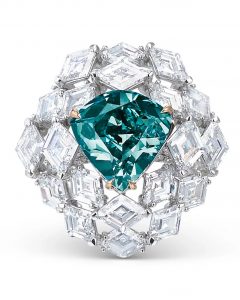
The breathtaking 5.51 fancy vivid blue-green diamond, cut in a triangular shape, is unlike any other diamond on Earth. “I could spot it from across the room,” said Moses. “I have never seen a natural blue-green diamond of this intensity of color, size, and it is a Type IIa, which certainly makes it a unicorn.”
The only diamond that comes close is the Dresden Green, he says. But even the 42-carat green diamond, also a Type IIa (a category of diamonds that are the most chemically pure), doesn’t come close to the Ocean Dream’s electric color. Until the Ocean Dream, Moses had only seen this shade of blue-green in stones of less than one carat, making this diamond a true natural wonder.
The Origin Story of the Ocean Dream Diamond
Discovered as an 11.7-carat rough in Central Africa in 2002, the Ocean Dream was purchased by Cora Diamond Corporation in New York. Moses conferred with the company over several months during the high-stakes cutting process, a particularly risky endeavor given the stone’s sensitivity to heat.
“It was a very tense cutting process because it was a gamble,” says Moses about the period more than 20 years ago when the stone was being polished, and that’s what makes his pulse race. The gamble paid off.
When the diamond first appeared at Christie’s Magnificent Jewels sale in May 2014, it fetched $9.8 million. It was a remarkable result at the time and, as today proved, just the beginning of its value story. It was offered in a sculpted rock crystal ring with pavé pink and white diamonds. To this day, it remains the largest fancy vivid blue-green diamond ever graded by the GIA.
“A stone of this rarity would likely command an even higher price at auction today,” said Moses. Moses was right. Today it did exactly that, and then some.
Why Collectors Covet Niche Colored Diamonds
“It’s an extremely rare stone,” says Max Fawcett, Christies’ Global Head of Jewelry. Unlike vivid pink or vivid blue diamonds, he calls the Ocean Dream a “niche fancy-colored diamond,” along with orange and pure green diamonds — colors that are almost unheard of. These niche colored diamonds appeal to a small but extremely knowledgeable group of collectors. When they do come up for sale, Fawcett notes, they spark fierce competition. “Those people who understand them realize how rare they are.”
Today’s result proved that point. The $17,300,000 price is not just a record for a blue-green diamond. It is a statement about what happens when something truly irreplaceable returns to the market after more than a decade. The Ocean Dream is the largest fancy vivid blue-green diamond the GIA has ever graded. There is no comparable stone.
The Ocean Dream’s appreciation from $9.8 million in 2014 to $17.3 million in 2025 mirrors a broader truth about rare natural diamonds. They do not lose value as supply increases, because supply cannot increase. The Earth produced one Ocean Dream. It produced it over billions of years through a combination of geological circumstances so specific and so unlikely that Tom Moses, in a career spanning five decades, had never encountered anything like it before or since. That is not a marketing claim. It is a geological fact. And today, the auction market confirmed exactly what that fact is worth.
A Cutting the Ocean Dream Diamond: A Stress-Inducing Process
At first glance, the stone’s arresting electric blue-green hue grabs your attention. And once you learn the remarkable science behind it, you realize why Moses refers to it as a unicorn—and why it makes his pulse race.
The blue-green color is the result of an extraordinary natural occurrence. “Most green diamonds owe their color to radiation exposure near the Earth’s surface over millions of years,” explains Moses. It’s serendipity that these events align at the precise temperature because if the stone heats up too much, the diamond’s green hue turns to brown or black. As a result, cutting is a make-or-break moment.
“The trick is to know how much to polish the stone’s surface, so you don’t lose the color, because you if you go too deep, you risk losing the radiation induced color,” said Moses. “You can easily turn a multimillion-dollar stone into a colorless diamond worth a fraction of that.”
Even its unique triangular shape was chosen for color preservation, not aesthetics. Staying as close to the rough shapes allows a better chance of retaining the color. During the cutting and polishing, the stone had to constantly be cooled because with radiation-induced color, if its temperature rises above 300 degrees Celsius you there is a risk it will turn brown.
“It was a very slow, tedious process,” said Moses. “The stone’s thermal conductivity works against you.”
The Ocean Dream Diamond Is a Legend Among Legends
The Ocean Dream Diamond made its public debut in 2003 as part of Smithsonian’s Splendor of Diamonds exhibit, a showcase of the world’s most rare and valuable diamonds, alongside the famous Moussaieff Red, De Beers Millennium Star, and Steinmetz Pink. After that it vanished into private hands, and today it is still whispered about among collectors.
A diamond of this nature always draws fascination. “Gemstones, particularly diamonds, are spellbinding,” said Moses.
“We think looking into a pool of water is soothing, but looking at a diamond with its brilliance and scintillation, well, that’s captivating.” The Ocean Dream is just that captivating, beautiful, and unforgettable.
Our special thanks to Jill Newman, and Only Natural diamonds for ths spectacular update
%Jeweler NYC %NYC Wholesale Diamonds

Leave a Comment

Filed under Uncategorized

CONGRATS TO ANNE AND SAM, ANOTHER HAPPY NYCWD COUPLE

%Jeweler NYC %NYC Wholesale Diamonds


Congrats to a most magnificent NYCWD couple, Anne and Sam on their spectacular wedding! Wishing you everything wonderful life has to offer together always! Thanks so much for this kind Five Star Google Review:

Keith is a true professional and provides an experience that is educational, positive, and pressure-free. A true partner in the process and we are extremely pleased with the end result. I highly recommend Keith and his team.

Sam Wiser

FIVE STARS

May 11, 2026

Leave a Comment

Filed under Uncategorized

DIAMOND INDUSTRY INSIDER UPDATE

US retail Diamond sales solid, especially in 2 ct. and larger sizes. Clarities ranging from VS-SI, Colors F-I the hottest diamonds in rounds and long fancies.
7 carats and larger, D-IF in hot demand ahead of GemGenève
show.
Elongated fancy shaped diamonds hard to find in larger sizes
Very positive developments

%Jeweler NYC %NYC Wholesale Diamonds

Leave a Comment

Filed under Uncategorized

A Closer Look at Zoë Kravitz’s Massive Diamond Engagement Ring

%Jeweler NYC %NYC Wholesale Diamonds


Zoë Kravitz and Harry Styles are reportedly engaged, and you know what that means: we have another celebrity ring to obsess over. Zoë unofficially debuted her engagement ring from Harry when they were spotted walking around London, but we’ve since gotten a closer look and it’s stunning.
Zoë’s ring appears to be a “10 or more carats, and likely an elongated cut,” at least according to gemologist and designer Monika Ruggerino in ELLE Australia. She adds, “At first glance, it reads as an elongated solitaire, likely 10 carats or more in an emerald or oval cut, placing its value comfortably above $500,000 AUD.” (This is around $355,000 USD.)
As for the designer, that info hasn’t been released. But now seems like a good time to mention that Zoë is the face of Jessica McCormack!
Reminder that Zoë and Harry have been dating since August of last year (at least, that’s when they were first spotted together), and things got serious fast. Obviously—this engagement comes less than a year after they first got together!
In February, a source told People that the pair “seem very serious and focused on prioritizing time together. They also seem to have created a life together that they both genuinely enjoy.”
Meanwhile, a Page Six insider said that Zoë’s been telling her friends that Harry’s “her soulmate” (same) AND someone told Us Weekly that “Zoë has maintained a lot of independence. Her family would joke that one of the reasons men would fall in love with her was because she kept an air of mystery and distance. With Harry, she is operating differently.”
Our thanks to Cosmopolitan and Mehera Bonner for this wonderful update


Leave a Comment

Filed under Uncategorized

DIAMOND INDUSTRY INSIDER UPDATE

%Jeweler NYC %NYC Wholesale Diamonds


Long fancy shapes such as Ovals, Marquises and Emeralds doing better than rounds in 2 ct. and larger sizes
High-quality Marquises, long Radiants and long Cushions in short supply.
Marquise is most expensive fancy shape.
Long Cushions easy to sell and trading at 20% to 25%
premium over square ones.
Solid US market for elongated Ovals of good shape

Leave a Comment

Filed under Uncategorized

Record Gold Prices Are Reshaping Jewelry: Here’s What Comes Next

%Jeweler NYC %NYC Wholesale Diamonds


Every year, jewelry trade shows set the tone for the fine jewelry industry. Retailers arrive looking for the pieces that will define their showcases. Designers unveil the collections they have spent the past year perfecting. And everyone quietly watches for the signals that reveal where the market is heading next.
Having just returned from the Arizona Biltmore, where this year’s Centurion Jewelry Show gathering once again brought together the industry’s most influential retailers and designers, one theme dominated nearly every conversation: gold.
But what surprised me most was how the historic surge in gold prices is reshaping the fine jewelry industry.
For anyone outside of the trade, Centurion might not sound familiar. However, this invite-only show serves as the unofficial kickoff to the fine jewelry year in the United States.
Held at the legendary Arizona Biltmore, the Frank Lloyd Wright–designed resort transforms into a meeting place for the country’s top retailers and designers. Buyers preview new collections months before they hit store windows, and designers gauge how their ideas resonate with the people who ultimately bring jewelry to consumers.
If you want to understand what engagement rings, diamond jewelry, and gold pieces people will be wearing later this year, Centurion gives you the first clues.
This year, however, everyone kept circling back to one topic: the price of gold.
Gold trades much like stocks, with prices fluctuating constantly in response to global markets, economic conditions, currency movements, and investor sentiment. Jewelry manufacturers watch gold prices as closely as financial analysts watch the S&P 500 because even small changes in gold prices can dramatically affect production costs.
And the last year has been anything but small.
In January 2025, gold hovered around $2,600 per ounce. Fast-forward one year, and prices surged toward $5,000 per ounce heading into this year’s Centurion show. Just days before the event began, prices spiked to nearly $5,600, only to plunge back to $4,600 two days later. As I write this now, gold has climbed back above $5,000.
These swings have shattered historical expectations and left both financial markets and the jewelry industry asking the same question: what happens next?
But here’s what truly fascinated me at Centurion: instead of shrinking gold usage to keep prices lower, designers and retailers are doing the opposite.
Conventional wisdom suggested designers would reduce gold weight, hollow out pieces, or shift toward lighter construction to control prices. Instead, retailers consistently told me customers now want heavier, chunkier gold jewelry.
Why?
Because consumers understand now more than ever that gold has real value. When someone buys a substantial gold necklace or ring today, they know they are wearing something intrinsically valuable. They want to see it. They want others to see it.
Designers responded accordingly. Across the show floor, collections leaned heavily into bold yellow gold, sculptural forms, and substantial pieces that proudly showcase their gold content.
Gold is no longer just the framework. It is one of the stars.
And surprisingly, this environment also boosts natural diamonds.
Why Rising Gold Prices Are Benefiting Natural Diamonds
Natural diamonds and gold share something critical: both derive value from rarity in nature. However, natural diamonds are even rarer than gold, which has historically made diamond jewelry more expensive.
In the past, some designers limited the use of natural diamonds because they significantly increased production costs. But with gold prices now so high, the balance shifts.
Gold itself now accounts for a much larger share of a jewelry piece’s value. As a result, adding natural diamonds increases the price by a proportionally smaller amount than it once did.
That shift became obvious at Centurion.
Designers known primarily for colored gemstones now incorporate more natural diamonds into their collections. Meanwhile, houses already focused on diamonds push toward even larger stones in bolder, heavier designs.
Natural diamonds suddenly make even more sense in luxury jewelry, especially as consumers increasingly seek purchases that feel meaningful and lasting.
Another important theme I heard repeatedly from retailers involves how consumers view fine jewelry today.
People increasingly want purchases that carry emotional meaning while also holding long-term value. Fine gold jewelry set with natural diamonds answers both needs.
Natural diamonds have appreciated in value approximately 3 percent annually over the past six decades. Combine that with record gold prices, and fine jewelry becomes not only beautiful but financially resilient over time. While this has been true for decades, the global spotlight on gold has helped consumers better understand its validity.
People gravitate toward assets they can enjoy while also trusting their enduring worth. Fine jewelry is one of the few things that sits at that intersection.
Our special thanks to Diamond Industry Expert Grant Mobly for this fascinating article

Leave a Comment

Filed under Uncategorized