Diamonds, a better safe haven than Gold?

%Jeweler NYC %NYC Wholesale Diamonds

The following is an article written by Suzanne McGee from the MSN Money Website. It is a wonderful follow-up to the May 10 NYC Diamond Blog post ‘Diamond Mutual Funds are Coming’, but with a fascinating new twist. In the last paragraph I added in bold a suggestion that as a result of the introduction of Diamond Funds, consumers might just receive something they have desired for decades. That is the first ever Spot Market Price for Diamonds.

Are diamonds an investor’s best friend?

The collapse of gold prices earlier this spring seems to have been met with a kind of muted elation from those promoting the idea that diamonds, like the precious metal, could become a recognized asset class and another form of haven investment.

It’s perfect timing for the diamond industry: With an exchange-traded fund backed by diamonds due to roll out sometime next year, once it has received the stamp of approval from the U.S. Securities & Exchange Commission, supporters of the idea admit that they need to educate investors in North America on the advantages of diamonds as investments.

“America views diamonds primarily as pieces of jewelry; in places like India, China and Russia, people traditionally have viewed them as investible assets,” says Kristopher Schellhas, managing partner and co-founder of the Los Angeles-based Investment Diamond Exchange, which offers a marketplace for trading the precious gems. Schellhas is correct about that: For centuries, diamonds have been a way for the wealthy or merely affluent to make their riches readily transportable in times of peril. But does that make them a good investment idea?

Until now, investing in something that is simply called a “diamond” has been a bit like buying a work of art referred to as a “Picasso.” Just as you don’t know whether the latter is a reproduction, a sketch by the artist himself on a piece of newspaper, or the massive “Guernica,” in the case of diamonds an investor wants to be sure he or she is getting something of value, not a tiny chip off a muddy, poor-quality stone.

One part of the conundrum is in the process of being solved. GemShares, the company behind the proposed diamond ETF, last year patented a global standard for investment-grade diamonds. “This was done specifically so they could be used as financial instruments,” says Schellhas. “It’s a precursor for diamonds being publicly traded.”

The goal is to create a homogenous group of diamonds with clearly defined characteristics that are indistinguishable from each other — a range of sizes is fine, but all should be a generic round brilliant cut, and have a top-tier clarity rating. (If you want the full details, check out the patent application). With the patent in place, GemShares has created something as close to a commodity as may be possible in the world of precious stones, given that no two diamonds ever will be identical.

But simply being objects of value and becoming fungible enough to be defined as a tradable asset class won’t be enough to make diamonds a mainstream commodity investment — for reasons that go well beyond their very speculative nature.

Gold, for instance, has been traded on open markets for generations, resulting in a benchmark price for the physical item that has been transparent. In contrast, the history of diamond pricing is murky indeed: For most of the last century or more, prices were largely under the control of the De Beers syndicate. When the market changed, De Beers simply refocused its marketing strategies to keep prices high. For instance, when an influx of new, smaller diamonds from the former Soviet Union hit the market in the 1950s and onward, it pushed the idea of the eternity ring, made up with lots of smaller diamonds. An open market has only begun to develop since 2005, when De Beers finally agreed to resolve several U.S. class action suits by plaintiffs alleging price-fixing. In other words, investors looking for a history of price discovery will seek in vain.

The question of near-monopolies in the diamond mining industry still exists as an investment risk, according to the diamond ETF prospectus filed with the SEC. “Large companies represent a sufficiently large share of the diamond supply and intermediate demand in the production cycle,” the prospectus spells out, that their activities may weigh on prices. Another issue that Schellhas identifies as a plus for the ETF is labeled a risk in the prospectus. The ETF will be backed by a physical inventory of gems (just in case you want to take delivery of your investment at some point in time) and not just mirror the performance of the assets on paper. That means that GemShares will be buying diamonds to deposit into the trust backing the ETF.

To Schellhas, that’s good news: it will buoy diamond prices. But that may also mean that the price of the initial units will be higher (because of the larger prices paid for the diamonds) and that since this demand isn’t sustainable or ongoing, there may be a selloff in the aftermarket.

Then there is the pesky question of liquidity, both for diamonds themselves and for the ETF.

Until now, most diamond investment vehicles that have been created have been private pools, units of which have been sold to institutions or ultra-wealthy investors. Many of those pools focus more on large, rare high-quality stones than on the smaller “commodity” diamonds of the kind that GemShares proposes using as a base for its ETF. There’s a reason for this:

The diamond investment market is still embryonic and risky for those who aren’t pros.

For ordinary investors — the kind for whom a loss can be a real setback — it’s too early to contemplate investing in diamonds, however disappointed they may be with gold prices right now.

Yes, there is potential for diamond investing to grow. As Schellhas points out, while about 40% of the gold market is dominated by speculators or investors, only about 1% of the diamond market is made up of speculative activity. But speculation isn’t long-term investing. And even if diamond supply does remain static while the number of middle-class households grow worldwide, that isn’t to say that those middle-class consumers will choose to spend their new disposable income on diamonds.

Questions of price transparency and liquidity alone make this a risky bet. It’s telling that Schellhas describes the ETF as the vehicle that will end up creating the first spot market price for diamonds. Typically, a commodity-related structured investment product makes its debut in the wake of the establishment of a reliable spot market with a history of price transparency. This time, the promoters of the diamond ETF seem to be doing it the other way around, relying on the product itself to generate enough buzz to make it a success. That’s hardly the kind of risk-free strategy you’d want to find in a safe haven investment.
Leave a Comment

Filed under Uncategorized

$15 Million Black Diamond iPhone

%Jeweler NYC %NYC Wholesale Diamonds

Family heirlooms are often packed away for safe keeping. For one man from China, hiding a 26-carat black diamond worth $14.5 million was not in his plans.

A businessman from Hong Kong commissioned craftsman Stuart Hughes of Liverpool to help him show off his family treasure.

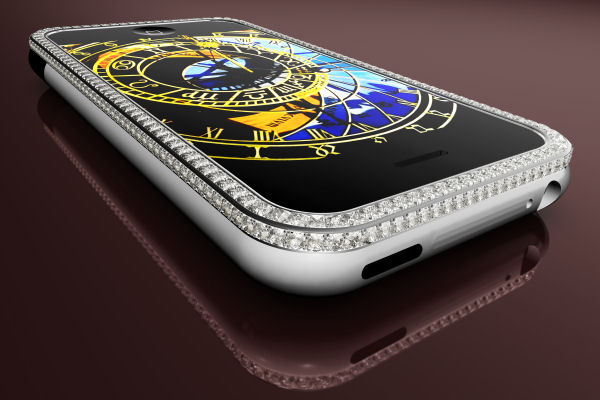
The result? An iPhone 5 boasted by Hughes to be “the world’s most expensive phone,” valued at $15 million.

According to Hughes’ website, this iPhone includes 600 flawless white diamonds, a full solid gold dressing and 53 diamonds on the rear that make up the iconic Apple logo.

However, the reason this particular iPhone is so valuable is on the face of the phone.

The Chinese businessman, identified only as “Joe,” contacted Hughes and asked to have a rare, black diamond incorporated into the iPhone.

“It’s not often that people get to deal with a very, very rare diamond,” Hughes said.

Hughes said he was contacted 18 months ago by Joe, who expressed interest in his gold chassis iPhone handsets.

Joe then told Hughes about the black diamond that had been in his family for generations. Hughes spent nine weeks creating the solid gold chassis of an iPhone 5 and then placed the black diamond as the home button.

The appraisal Joe had done on the black diamond put its value at approximately $14.5 million, according to Hughes, who said he saw the certificate of authenticity.

Hughes told CNN that one of the solid gold handsets with the diamonds that he crafts is worth approximately $153,000.

“We had a tech guy in Macau who was able to set the stone, which to this day has never left China,” Hughes said.

Hughes set a record in 2011 for crafting an iPhone 4S with 500 individual diamonds, totaling more than 100 carats. That phone was estimated to be valued at $9 million.

The 42-year-old craftsman is known for making lavish and expensive items, including an iPad made of solid gold he debuted two years ago.

“I am a craftsman,” Hughes said. “I basically fulfill and make up these ideas.”

Throughout the years and his many projects, Hughes said this particular handset is right up near the top of the most lavish projects he’s completed.

Leave a Comment

Filed under Uncategorized

Diamond Mutual Funds are Coming

%Jeweler NYC %NYC Wholesale Diamonds

GemShares, a Chicago-based financial firm, has put into registration a physical diamond trust that follow by eight months or so the first round of news suggesting the firm was looking to patent a process for having diamonds become tradable securities.

The GemShares Physical Diamond Trust sets out to reflect the wholesale price of diamonds included in a fungible basket-called the “GemShares Global Investment Grade Standard Diamond Basket”-minus expenses, according to the filing submitted to regulators this week.

The filing is vague on the details. While it does say that each basket will consist of three “weight classes” of diamonds-each class comprising gems that meet specific weight criteria-it doesn’t say what that criteria is or what the total weight of each basket will be. Keith Saxe of NYC Wholesale Diamonds in The New York Diamond District feels “The ETF will at least initially contain only GIA Certified Brilliant Cut Round Diamonds of VS Clarity and G Color and above.

It also fails to disclose the custodian of the diamonds, or how much it will costinvestors to own shares of the trust. It does say that only authorized participants will be allowed to redeem shares for diamonds-an arrangement that seems akin to the way the SPDR Gold Trust (NYSEArca:GLD) is organized. GLD only allows redemption for physical gold for lots of 100,000 shares or more.

Diamonds neither have the financial history of gold nor do they work as a hedge against a falling currency, Index Universe’s Stacey Brorup pointed out in a blog last year.

In fact, only 30 percent of mined diamonds are of gem quality, meaning an investor who buys into GemShares’ trust would in theory be missing out on 70 percent of the market. Natural diamonds are also used industrially.

Still, GemShares is not the first to plan a physical diamond ETF Rye Brook, New York-based IndexIQ, too, put a diamond ETF into registration a year ago.

“The shares are designed for investors who seek a cost effective, transparent and convenient way of making an investment similar to an outright investment in physical diamonds,” GemShares said in the filing.

Diamonds included in the trust must meet certain physical and optical standards, as well as be a conflict-free gem, the filing said. No ticker was disclosed.


Leave a Comment

Filed under Uncategorized

How Diamonds Became Forever

%Jeweler NYC %NYC Wholesale Diamonds

Peggy Olson, that emblem of the pioneering ad woman in a man’s world on the television show “Mad Men,” would have been all of 8 years old on the night in 1947 when the real-life copywriter Frances Gerety coined the phrase “A Diamond Is Forever.”

As Ms. Gerety recalled in a 1988 interview with a co-worker, Howard Davis, she had just finished a series of ads and was headed to bed when she realized that she had forgotten to create a signature line. Exhausted, she said “Dear God, send me a line,” and scribbled something on a slip of paper. When she woke up and saw what she had written, she thought it was just O.K. A few hours later, she presented her idea at a meeting. According to her, “Nobody jumped.”

When Ms. Gerety applied to work at the Philadelphia advertising agency N.W. Ayer & Son in 1943, she was told that her timing was perfect: the agency had just lost a female copywriter. At the time, women were usually hired to write for women’s products only. Her main account would be De Beers. For the next 25 years, she wrote all of the company’s ads.

Her counterpart in publicity was Dorothy Dignam, a plucky brunette who kept a list of questions male co-workers asked her in the drawer beneath her typewriter; things she was meant to know as a woman, like, “Could a winter hat have a bird’s nest on it? Is Macy’s singular or plural? What do you give a girl graduating from a convent? Is this thing an inverted pleat?”

Neither Ms. Gerety nor Ms. Dignam ever married. But their greatest professional achievement arguably was helping to create a sense of emotional attachment to the diamond engagement ring.

It’s hard to imagine a time when diamond engagement rings were not the norm; today, even after a decade and a half of bad press about blood diamonds and working conditions in the mines, among other concerns, 75 percent of brides in the United States wear one, according to Kenneth Gassman, president of the Jewelry Industry Research Institute.

Last year, Americans spent almost $7 billion on the rings. But in 1938, when a De Beers representative wrote to N. W. Ayer to inquire whether “the use of propaganda in various forms” might boost the sale of diamonds in the United States, their popularity had been on a downward trend, in part because of the Depression.

N.W. Ayer conducted extensive surveys of consumer attitudes and found that most Americans thought diamonds were a luxury for the ultra-wealthy. Women wanted their men to spend money on “a washing machine, or a new car, anything but an engagement ring,” Ms. Gerety said in 1988. “It was considered just absolutely money down the drain.”

Still, the agency set an ambitious goal: “to create a situation where almost every person pledging marriage feels compelled to acquire a diamond engagement ring.”

Because De Beers controlled the world supply of rough diamonds, antitrust laws prohibited the company from doing business in the United States. The ads could not promote De Beers, or even show pictures of jewelry, so the agency commissioned bold paintings by artists like André Derain and purchased pre-existing works by Dalí and Picasso.

“Sentiment is essential to your advertising, as it is to your product,” it counseled De Beers in a memo, “for the emotional connotation of the diamond is the one competitive advantage which no other product can claim or dispute.”

Ms. Gerety’s early copy sometimes bordered on the heavy-handed. A typical wartime ad read: “Star of Hope: The engagement diamond on her finger is bright as a tear — but not with sadness. Like her eyes it holds a promise — of cool dawns together, of life grown rich and full and tranquil. Its lovely assurance shines through all the hours of waiting, to kindle with joy and precious meaning at the beginning of their new life to be.”

Meanwhile, Ms. Dignam was busy making sure average consumers saw diamonds everywhere. Her theory was that “the big ones sell the little ones.”

Capitalizing on the country’s newest obsession, she wrote a monthly letter to newspapers describing the diamond jewelry worn by Hollywood actresses. She sometimes appeared as a guest columnist on the women’s pages, writing under the name Diamond Dot Dignam. (“Jimmy Durante’s valentine to his dream girl, Margie Little, was an eye-opening diamond ring. Rosalind Russell wears only two costumes in ‘The Guilt of Janet Ames,’ but one of them consists of three and three quarters pounds of diamonds and only two and a half pounds of foaming tulle and net and sequins.”)

In the 1950s, N. W. Ayer started lending jewels to socialites and starlets for the Academy Awards and the Kentucky Derby. The campaign was a success from the start. After just two years, the sale of diamonds in the United States increased by 55 percent. In its 1951 annual report, N. W. Ayer noted that, “for a number of years we have found evidence that the diamond engagement ring tradition is consistently growing stronger. Jewelers now tell us ‘a girl is not engaged unless she has a diamond engagement ring.’ ”

The company also succeeded in promulgating ideas like the Four C’s, which arose from a surplus of very small stones. Buyers had been taught that bigger meant better, and had no interest. So N. W. Ayer added a box labeled “How to Buy a Diamond” to every ad, with the instructions: “Ask about color, clarity, and cutting — for these determine a diamond’s quality, contribute to its beauty and value. Choose a fine stone, and you’ll always be proud of it, no matter what its size.” (The final “c” stood for carats.)

In the 1980s, the agency introduced a series of ads setting a new arbitrary but authoritative-seeming benchmark: “Isn’t two months’ salary a small price to pay for something that lasts forever?”

Some attempts at changing cultural attitudes were more successful than others. The agency briefly tried to get men interested in wearing diamond rings. A representative ad features a shaggy-haired couple in pajamas, playing checkers in bed: “She has a mind of her own. She gave me a diamond.”

The “Women of the World, Raise Your Right Hand” campaign of 2003 also met with some eye rolls, though it owed a debt to a 1965 series of Ms. Gerety’s that featured “bachelor girls, divorcées, widows, or career women buying ‘on their own’ as well as some married women,” according to her assignment. “That part of the market which for one reason or another is either less, or not at all, motivated by copy appeals rooted in love.”

Deanne Torbert Dunning, N. W. Ayer’s first female vice president on the creative side, wrote the account during the turbulent years of 1968 through 1970.

“You had Betty Friedan and ‘The Feminine Mystique,’ you had the Pill, and by 1970, you had a full-blown women’s movement,” she recalled by phone recently. “There was an anti-establishment feeling. Whatever my mother had, I don’t want. So the ads shifted to a more everyday, casual approach. They said, ‘Yes, you can get married barefoot on a beach, but don’t you still want a beautiful ring?’ ”

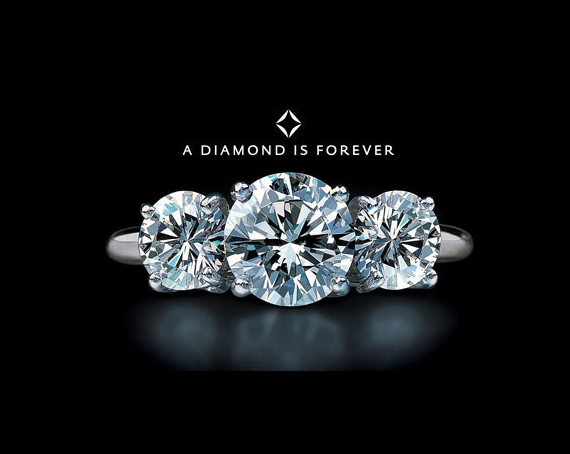
But one thing, at least, has remained firmly established: the line “A Diamond Is Forever,” which has appeared in every De Beers engagement ad since 1948. In 1999, two weeks before Ms. Gerety died at the age of 83, Advertising Age named it the slogan of the century.

The preceding was an article written by J Courtney Sullivan in the May 3, 2013 edition of the N.Y. Times


Leave a Comment

Filed under Uncategorized

U.S. Market Favors Bridal Jewelry, H SI Stones, Says De Beers

%Jeweler NYC %NYC Wholesale Diamonds


The U.S. diamond market is built on bridal jewelry and H SI stones, says a new market outlook from De Beers

The company’s surveys say the best-selling diamonds in the United States fall in the 0.5–0.99 ct. range, with H or better color and SI clarity.

The market also mostly favors bridal jewelry, with engagement ring sales outpacing other sales of other types of diamond jewelry.

Overall, the American market remains the biggest diamond consumer market, its overall share of the diamond market is falling. America’s share now stands at 37 percent, versus 42 percent in 2007, and around 50 percent at the beginning of the century. The U.S. diamond market grew some 5 to 6 percent percent in 2012, as did Japan’s. 

China now stands as the second biggest market, claiming 11 percent of the diamond consumer total, followed by Japan (10 percent), and India (9 percent). Last year, the Chinese market grew some 8 to 10 percent in dollar terms, while the Indian consumer market for diamonds contracted some 5 percent in dollar terms but grew 9 percent in local currency. 

For 2013, the company expects growth rates to consolidate in China; positive but lower-than-average demand growth in Japan; and a better picture to emerge in India.

Other market reports:

– In India and Japan, non-bridal multi-diamond rings were much more popular than in other major markets.

– Solitaire diamond products were prevalent in China, mainly for bridal occasions and wedding anniversaries.


Leave a Comment

Filed under Uncategorized

Gatsby Jewels

%Jeweler NYC %NYC Wholesale Diamonds

Movies and TV shows depicting life in the “Roaring 20s” have risen to prominence in pop culture as of late–namely PBS’ Downton Abbey and the upcoming feature film The Great Gatsby–leading to a resurgence of styles from this era, not only in clothing but jewelry as well.

Jewelry reminiscent of the Art Deco period includes streamlined and curved pieces, angular lines and geometric shapes. Filigree also is a common characteristic. Long earrings, cocktail rings and pearls are staples from this era, as are long necklaces with tassels. Tiffany & Co has launched a new collection with Catherine Martin, the costume designer behind Gatsby. The luxury brand- which designed all the jewelry for the upcoming movie took inspiration from their antique designs, with a modern twist. Opulent pieces from the collection evoke the Roaring 20’s. Jon King, Tiffany executive vice president said in a statement: ‘The jewelry symbolizes the story’s themes of wealth and privilege, and we approached its design with the utmost style and luxury in mind.’

Only shoppers with the most expensive tastes will be able to purchase these pieces at Tiffany, though, which cost up to $900,000 for a flower-shaped diamond ring.

But do not despair, NYC Wholesale Diamonds and it’s Fine Jewelry designer division are offering our collection of these styles at prices starting at $ 1,500.

British actress Carey Mulligan was constantly shadowed by a security guard on “The Great Gatsby” set because she was draped in diamonds worth millions of dollars for her role as Daisy Buchanan.

The “Drive” star wore luxurious pieces created especially for the movie by jewelers at Tiffany & Co, and executives at the company employed a guard to watch over the actress at all times.

Mulligan insists the security measures were distracting as she was constantly watched, even when she was trying to work.

She tells Britain’s Daily Mail, “I would be doing a scene, wearing these fabulous jewels from Tiffany’s worth many, many millions. There’d be diamond bracelets on each arm, and diamond earrings, and rings, and strings of pearls around my neck. And I could see this guy in the corner watching me intently, in case I ran off with anything.”


Leave a Comment

Filed under Uncategorized